
Views: 0 Author: Site Editor Publish Time: 2026-08-26 Origin: Site


Component failure in heavy-duty industrial applications results in catastrophic downtime, safety hazards, and compounding financial losses. Engineering and procurement teams must balance manufacturing methods, geometric complexity, and lead times against the non-negotiable mechanical reliability required for high-stress environments. When evaluating structural integrity, the debate between forging and casting ultimately comes down to metallurgical alignment. Forging manipulates the metal's grain structure to follow the component's geometry, creating superior directional strength. Casting melts and pours metal, resulting in a uniform but generally weaker isotropic structure.
Moving beyond basic definitions, this guide provides a metallurgical and operational evaluation of forging versus casting. We detail how grain structure manipulation impacts tensile strength, fatigue resistance, and overall lifecycle longevity. You will gain the technical data needed to specify the right manufacturing process for critical load-bearing components.
Directional vs. Isotropic Strength: Forging aligns the metal's grain structure to the part's contours, offering superior directional strength, whereas casting provides uniform, multi-directional (isotropic) strength.
Measurable Performance Gaps: Forged components typically exhibit up to 26% higher tensile strength and up to 37% higher fatigue strength compared to cast equivalents.
Application-Specific Superiority: High-impact, cyclic-load applications demand forging, while highly complex internal geometries or exceptionally large components often necessitate casting.
Establishing baseline mechanical requirements is mandatory before selecting a manufacturing process. Strength is not a single, universal metric. It represents how a specific material reacts under varying types of mechanical stress. Success criteria depend entirely on the operational environment, load direction, and lifecycle expectations. Engineers must evaluate the specific forces the component will endure daily. A part designed to hold static weight requires different metallurgical properties than a part subjected to constant vibration or sudden impacts.
We see this constantly in heavy construction. An excavator bucket pin takes massive shear loads every time the operator curls the bucket. If you specify the wrong manufacturing method for that pin, it snaps, dropping the load and shutting down the site. Defining these parameters early prevents over-engineering and eliminates the risk of premature structural failure. You have to know exactly what the part will do before you decide how to make it.
Evaluating the maximum stress a component can withstand requires understanding the difference between tensile and yield strength. Tensile strength, or ultimate tensile strength (UTS), measures the maximum amount of stretching or pulling force a material handles before fracturing completely. Yield strength marks the exact point where plastic deformation becomes permanent. Once a material passes its yield point, it will not return to its original shape.
In critical industrial applications, operating near the yield point is dangerous. Components must possess high yield strength to maintain dimensional stability under heavy loads. Forging consistently elevates both yield and tensile strength by eliminating internal voids and refining the crystalline structure of the metal. When you compress the metal under thousands of tons of pressure, you force the molecules closer together. This density directly translates to higher yield points.
Mechanical Property | Cast 4140 Steel (Typical) | Forged 4140 Steel (Typical) | Performance Delta |
|---|---|---|---|
Ultimate Tensile Strength (MPa) | 850 | 1080 | +27% |
Yield Strength (MPa) | 550 | 890 | +61% |
Elongation (%) | 12% | 18% | +50% |
Impact Toughness (Joules) | 25 | 55 | +120% |
Analyzing how components survive repeated stress cycles over time without micro-fracturing is a critical factor for lifting hardware like shackles, rigging, and suspension parts. Cyclic loading destroys components over time through microscopic wear. A part might easily handle a massive single impact but fail after a thousand smaller impacts. Fatigue resistance measures this exact endurance limit.
Repeated stress causes microscopic cracks to form at stress concentration points. Over time, these micro-fractures propagate through the material until catastrophic failure occurs. Manufacturing processes that leave internal porosity or uneven grain structures severely reduce fatigue resistance. Smooth, continuous grain flows act as a barrier to crack propagation. When a micro-crack tries to form in a forged part, it hits the dense, aligned grain boundary and stops. This mechanism significantly extends the operational lifespan of the component under cyclic stress.
Torsional stress twists materials along their axis, while shear stress pushes different parts of the component in opposite directions simultaneously. Components like crankshafts, axles, and a Heavy Duty Forged Steel Drive Yoke require specific directional strength profiles to prevent catastrophic shearing under massive torsional load.
When sudden torque is applied, the internal grain structure must resist the twisting force. If the metal grains are randomly oriented, the shear forces will find the path of least resistance and tear the metal apart. Aligning the grain flow parallel to the anticipated shear forces drastically increases the torque capacity of the part. This directional alignment is the primary defense against sudden mechanical shearing in power transmission applications. You cannot replicate this directional defense with a poured casting.
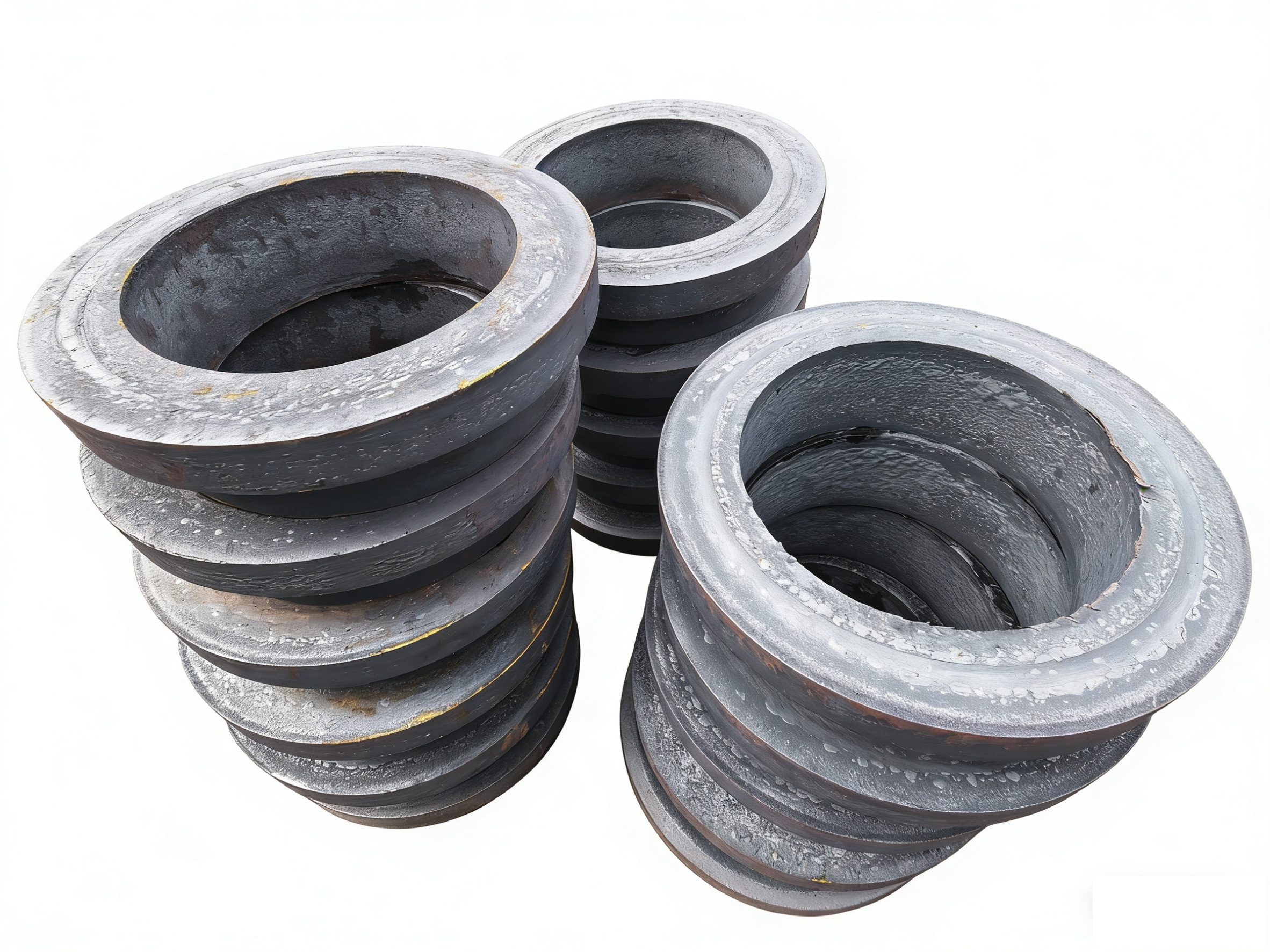
Localized compressive forces, applied through thermal and mechanical pressure, plastically deform the metal and realign the grain structure during deformation. As the raw billet is heated and hammered into the die, the internal crystalline structure stretches and bends. This continuous grain flow aligns perfectly with the external contours of the part. The extreme pressure effectively welds shut any microscopic internal voids, eliminating porosity.
High-quality forging parts rely on this exact metallurgical transformation to achieve maximum density and structural integrity. The process physically changes how the metal behaves. We use massive hydraulic presses or drop hammers to force the heated steel into the closed die. The metal has nowhere to go but into the exact shape of the cavity, taking its grain structure with it.
Machining a part from a solid billet is inherently weaker than forging. When you machine a component, the cutting tools slice directly through the natural grain structure of the metal. This leaves exposed grain ends at the surface, creating natural stress concentration points where cracks can initiate. Forging bends and preserves the grain structure, wrapping it around corners and contours. This unbroken structural flow provides unparalleled resistance to impact and fatigue.
Billet Heating: The raw steel is heated to its plastic deformation temperature, usually above 1,200 degrees Celsius for steel alloys.
Pre-Forming: The billet is roughly shaped to distribute the mass correctly before entering the final die.
Closed-Die Compression: The metal is forced into the final die cavity, aligning the grain flow with the part's geometry.
Trimming: Excess metal (flash) that squeezed out of the die is trimmed away.
Heat Treatment: The part undergoes normalizing, quenching, and tempering to lock in the desired mechanical properties.
Casting involves pouring molten metal into a mold and allowing it to solidify. As the liquid metal cools, crystals form and grow randomly until the entire part is solid. This random grain orientation yields uniform baseline strength throughout the part. Because the grains do not align in any specific direction, the material exhibits isotropic properties. It offers the same mechanical strength regardless of which direction the force is applied.
While this uniformity is useful for certain static applications, it lacks the optimized directional load-bearing capacity required for extreme stress environments. The casting process carries inherent metallurgical risks. As molten metal cools, it shrinks. This cooling process can create micro-shrinkage cavities inside the part. Additionally, gases trapped in the molten metal can form gas porosity, leaving microscopic bubbles within the solid structure.
Inclusions from the mold material or impurities in the melt can also compromise the metal matrix. These internal defects act as stress risers, significantly lowering the overall tensile and yield strength of the cast component. If a load hits a cast part right where a microscopic gas bubble sits, the part will fracture.
Micro-shrinkage: Tiny voids formed when the liquid metal contracts during cooling, weakening the internal structure.
Gas Porosity: Trapped hydrogen or nitrogen bubbles that fail to escape before the metal solidifies.
Sand Inclusions: Bits of the sand mold that break off and become embedded in the final metal part.
Hot Tears: Cracks that form during the cooling phase due to uneven thermal contraction across complex geometries.
Metallurgical data consistently proves why forged components outperform castings in ultimate tensile strength. Benchmark tests on industrial hardware demonstrate a 26% tensile strength advantage for forged parts over their cast equivalents. The absence of internal voids and the refined grain structure allow the metal to handle significantly higher stretching forces before failure. This measurable performance gap dictates material selection in heavy industries where failure is not an option.
Fatigue life extensions are even more pronounced. Forged parts operating under continuous high-pressure cycles exhibit up to 37% higher fatigue strength. Components like Custom Hydraulic Cylinder Forging Parts endure thousands of pressurization cycles daily. The continuous grain flow prevents micro-cracks from forming under this relentless cyclic loading. Cast parts, with their random grain orientation and potential micro-porosity, succumb to fatigue much faster under identical operating conditions.
We test these limits in the field. A cast hydraulic cylinder cap might last 5,000 hours on a mining excavator before hairline cracks appear around the bolt holes. A forged cap in the exact same application easily pushes past 15,000 hours. The data aligns perfectly with the physical reality of the job site.
The optimized grain structure and absence of internal voids in forgings allow engineers to design lighter, thinner components. Because the metal is inherently stronger and denser, less material is needed to achieve the required load capacity. Engineers can reduce the cross-sectional area of a part without sacrificing safety or performance. This optimization directly impacts the overall efficiency of the mechanical system.
Weight reduction creates cascading benefits across multiple industries. In aerospace applications, lighter components translate directly to fuel savings and increased payload capacity. In automotive and heavy machinery sectors, reduced unsprung weight improves handling, reduces wear on surrounding components, and lowers energy consumption. Maximizing the strength-to-weight ratio through forging delivers compounding operational efficiencies over the lifespan of the equipment.
Component Type | Cast Weight (kg) | Forged Weight (kg) | Weight Reduction |
|---|---|---|---|
Heavy Duty Steering Knuckle | 45.2 | 36.5 | 19.2% |
Industrial Crankshaft | 120.0 | 98.5 | 17.9% |
Suspension Control Arm | 18.5 | 14.2 | 23.2% |
Pipeline Valve Body | 85.0 | 71.0 | 16.4% |
Applications requiring maximum reliability under impact, high wear, and directional stress demand forged components. When a part serves as a critical load-bearing link in a mechanical system, the continuous grain flow of a forging provides the necessary safety factor. High-stress environments simply do not tolerate the internal inconsistencies inherent in cast materials. You specify forging when human safety or massive operational downtime is on the line.
Use cases demanding high structural integrity and tight tolerances rely heavily on advanced forging techniques. For example, High Strength Seamless Rolled Ring Forgings are strictly specified for wind turbine bearings and aerospace engine components. These parts face extreme radial and axial loads. The seamless rolled forging process ensures a perfectly circular grain flow, providing the exact directional strength required to prevent catastrophic failure under massive rotational forces.
Other common applications for forging include gear blanks, connecting rods, lifting hooks, and high-pressure fittings. Any component that takes a beating, twists under load, or holds back extreme pressure needs the density that only a forging press can provide.
Casting remains the optimal choice for components requiring highly intricate internal cavities. Engine blocks, complex valve bodies, and pump housings feature internal cooling jackets and fluid passages that are impossible or cost-prohibitive to forge. Sand casting and investment casting excel at creating these complex internal geometries in a single manufacturing step. You simply cannot forge a hollow, winding tube inside a solid block of steel.
Exceptionally large or massive scale components often necessitate casting. When a part exceeds the tonnage limits of available forging presses, casting is the only viable manufacturing method. Massive ship propellers, industrial machine bases, and large architectural nodes utilize casting. In these applications, the sheer mass of the component compensates for the lower baseline strength, and the uniform, multi-directional strength of the cast metal is sufficient for the operational environment.
Comparing the upfront capital expenditure of forging dies versus casting patterns reveals distinct economic profiles. Forging requires precision-machined, hardened steel dies capable of withstanding immense thermal and mechanical shock. These dies represent a significant initial investment. Casting patterns, typically made from wood, plastic, or softer metals, are substantially cheaper to produce. For low-volume production runs or rapid prototyping, casting offers a lower barrier to entry.
Calculating the break-even point dictates the economic viability of forging. As production volumes increase, the high initial cost of forging dies is amortized over thousands of parts. Forging dies possess long operational lifespans, producing highly consistent parts with minimal degradation. At high volumes, the unit cost of a forged part drops significantly, making it highly competitive with casting, especially when factoring in the reduced need for secondary processing.
Modern closed-die forging delivers impressive near-net-shape capabilities. The process forms the metal very close to its final required dimensions. This precision drastically reduces the amount of raw material required per part. Less material input translates directly to lower raw material consumption and reduced environmental impact. You buy less steel, and you throw less steel away.
Comparing secondary machining costs highlights another advantage of near-net-shape forging. Castings often require extensive machining to achieve final tolerances and smooth surface finishes. This secondary machining consumes time, accelerates tool wear, and generates significant metal scrap. Forged parts require minimal finish machining. The reduction in machine time, extended cutting tool life, and lower scrap rates heavily influence the overall manufacturing economics.
Manufacturing Process | Grain Structure | Directional Strength | Porosity Risk | Best Application Use Case |
|---|---|---|---|---|
Closed-Die Forging | Continuous, aligned to contours | Exceptionally High | Virtually Zero | High-impact, cyclic load components (crankshafts, yokes) |
Sand Casting | Random, isotropic | Uniform but Lower | High (requires NDT) | Complex internal geometries (engine blocks, valve bodies) |
Machining from Billet | Straight, interrupted by cuts | Moderate | Zero | Low-volume prototypes, highly custom simple shapes |
Mitigating internal defect risks in castings requires strict adherence to Non-Destructive Testing protocols. Because casting inherently risks micro-shrinkage and gas porosity, manufacturers must verify internal solidity. Mandatory X-ray (radiographic testing) and ultrasonic testing penetrate the metal to reveal hidden voids. These testing protocols add time and effort to the casting process but are absolutely critical for safety-critical applications. If you skip the X-ray on a cast crane hook, you are gambling with lives.
Forging carries its own set of implementation risks that require careful mitigation. Improper heat treatment or flawed die design can cause flow faults, laps, or thermal cracking. If the metal cools too quickly during the forging process, internal stresses can fracture the part. Manufacturers mitigate these risks through precise temperature control, automated press operation, and rigorous die maintenance. Magnetic particle inspection (MPI) and liquid penetrant testing (PT) are routinely used to verify the surface integrity of finished forgings.
Ultrasonic Testing (UT): Uses high-frequency sound waves to detect internal flaws. Standard for thick forgings.
Radiographic Testing (RT): X-rays the component to find internal porosity. Mandatory for high-stress castings.
Magnetic Particle Inspection (MPI): Detects surface and near-surface cracks in ferromagnetic materials.
Liquid Penetrant Testing (PT): Uses colored dyes to reveal microscopic surface-breaking defects.
Evaluating vendor capabilities is a critical step in the procurement process. Assessing a metallurgical partner requires auditing their capacity for strict temperature control, die maintenance, and material traceability. A forging supplier must demonstrate consistent metallurgical expertise. Variations in heating times or press tonnage directly impact the mechanical properties of the final part. Procurement teams must verify that the supplier holds the necessary industry certifications and maintains robust in-house testing facilities.
Managing lead times requires understanding the realities of custom tooling. Creating custom hardened steel forging dies takes significantly longer than producing rapid sand-casting patterns. Engineering teams must factor these extended lead times into their project schedules. While casting allows for faster initial prototypes, forging provides superior long-term scalability and consistency once the dies are operational. You trade upfront time for long-term reliability.
Consult with a metallurgical engineer to conduct a finite element analysis (FEA) on your specific component design.
Identify the exact directional loads and fatigue cycles your component will endure in the field.
Request a prototype run or material test reports to validate the mechanical properties before committing to full-scale production.
Audit your chosen manufacturing partner's non-destructive testing (NDT) capabilities and quality control certifications.
A: Yes, in terms of tensile and fatigue strength. Forging eliminates internal voids and aligns the grain structure to the part's contours, resulting in a denser, stronger component. Castings have a random grain structure and are prone to internal porosity, making them generally weaker under high stress.
A: Directional grain flow aligns the metal's internal crystalline structure with the external shape of the part. This alignment acts like the grain in wood, providing maximum resistance against impact, shear, and torsional forces exactly where the component needs it most.
A: No. While advanced casting techniques and specific alloys can produce very strong parts, they cannot match the ultimate tensile strength of a forged equivalent. The inherent random grain orientation and risk of micro-porosity in castings prevent them from reaching forging strength levels.
A: Machining from billet is weaker than forging. Machining cuts directly through the metal's natural grain structure, creating exposed grain ends and stress concentration points. Forging bends and preserves the grain flow around the part's contours, maintaining structural integrity.
A: Forging requires high upfront tooling investments for hardened steel dies, making it less ideal for low volumes. Casting patterns are cheaper and faster to produce. However, at high production scales, forging dies last longer and reduce secondary machining needs.
A: These components endure extreme cyclic loading, massive torsional stress, and high-pressure impacts. Forging provides the continuous grain flow and superior fatigue resistance required to prevent catastrophic failure under these severe, repetitive operational conditions.
A: Engineers use destructive testing, like pulling parts to failure to measure ultimate tensile strength, and Non-Destructive Testing (NDT). NDT methods include ultrasonic testing, X-ray, and magnetic particle inspection to detect internal voids in castings and surface cracks in forgings.


