
Views: 0 Author: Site Editor Publish Time: 2026-08-05 Origin: Site


The operational lifespan and safety of heavy industrial equipment rely fundamentally on the metallurgical integrity of its forged components. Selecting the wrong metal grade introduces severe operational risks on the shop floor and in the field. Over-specifying materials leads to unnecessary procurement hurdles, excessive tooling wear, and extended machining times. Under-specifying results in premature fatigue, catastrophic failure, and severe compliance breaches under heavy loads. This guide provides a direct technical framework for evaluating and selecting the appropriate metal grades for industrial forging parts. You will learn how to balance mechanical properties, machinability, and application-specific demands to ensure optimal performance. We evaluate carbon steels, alloy steels, stainless variants, and non-ferrous options, detailing their specific industrial applications. By matching the exact metallurgical profile to the physical demands of the operating environment, engineering teams can prevent material misallocation and maintain structural reliability across all heavy-duty applications.
Material selection must align strictly with the operational environment, prioritizing specific mechanical properties (e.g., yield strength, impact toughness, corrosion resistance) over baseline material costs.
Carbon steels (like 1045/1050) offer optimal machinability and baseline strength for standard applications, while alloyed and stainless steels are mandatory for high-stress or corrosive environments.
The inclusion of specific alloying elements (chromium, molybdenum, nickel, manganese, tungsten) dictates the heat-treatment response and ultimate tensile strength of the final component.
Rigorous raw material validation, including chemical, mechanical, and dimensional checks, alongside adherence to metallurgical standards (e.g., ASTM, ASME), is critical to mitigating implementation risks.
You must define exact operational parameters before selecting a billet. A component operating in a sub-zero arctic environment requires vastly different impact toughness than one functioning inside a high-temperature steam turbine. Failing to define these parameters leads to immediate material failure in the field. You must map out exact load profiles, peak operating temperatures, and environmental exposures before reviewing any material data sheets.
Mechanical property requirements dictate the baseline evaluation metrics. You must weigh these metrics against the specific demands of your application. We evaluate materials based on four primary mechanical indicators:
Yield Strength: This determines the maximum stress a material can handle before permanent, plastic deformation occurs. Once a part yields, it loses its dimensional tolerance.
Ultimate Tensile Strength: This measures the absolute maximum stress a material withstands before fracturing completely.
Ductility: This indicates how much a material can deform under tensile stress without cracking. High ductility prevents sudden, brittle failures under shock loads.
Fatigue Resistance: This shows how well the metal withstands cyclic loading over time. Rotating shafts and axles rely heavily on high fatigue limits.
A strict inverse relationship exists between a material's as-forged hardness and its post-forging machinability. Harder materials resist deformation and wear in the field. They also rapidly degrade carbide cutting tools during secondary machining operations. You must balance the required final hardness with the practical limits of your shop's machining capabilities. Selecting an excessively hard material increases processing time, requires rigid machine setups, and drives up tooling consumption.
The forging process inherently improves the directional strength of the chosen material through grain flow optimization. As the metal deforms under the hammer or press, its internal grain structure aligns with the physical contours of the part. This continuous grain flow significantly enhances fatigue resistance and impact strength compared to parts machined from solid bar stock. Certain grades respond better to this structural refinement. You must select materials that maximize this directional strength advantage for high-stress geometries like crankshafts and lifting hooks.
Carbon steel remains the dominant material for standard industrial applications. The carbon content directly dictates the hardenability, strength, and ductility of the final component. We categorize these steels into low, medium, and high carbon grades based on their specific carbon percentages and resulting mechanical behaviors.
Low carbon steels, such as 1020, contain up to 0.30% carbon. They offer excellent ductility and superior weldability. These grades deform easily during the forging process, requiring lower tonnage presses. They cause minimal wear on forging dies. However, low carbon steels present severe limitations in achievable hardness. Heat treatment yields minimal strength improvements because there is not enough carbon to form a hard martensitic structure. You should specify low carbon steels only for lightly loaded components requiring extensive post-forge welding or severe bending operations.
Medium carbon steels, including 1045 and 1050, contain between 0.30% and 0.60% carbon. They provide an optimal balance of strength, impact resistance, and machinability. These grades respond well to quenching and tempering. They achieve sufficient surface hardness for most standard industrial applications while maintaining a tough, ductile core. Engineers frequently specify medium carbon steels for heavy-duty shafts, load-bearing gears, and Custom CNC Machined Flange Forging applications. They offer reliable performance without the processing difficulties and strict temperature controls required by higher alloy grades.
High carbon steels contain above 0.60% carbon. They deliver extreme hardness and exceptional wear resistance. Applications involving heavy friction, such as cutting tools, agricultural sweeps, or high-wear industrial blades, demand these grades. This increased hardness comes with significant manufacturing drawbacks. High carbon steels exhibit a sharp drop in ductility. They become brittle. The risk of internal cracking during the forging process increases substantially if the billet temperature drops below the optimal forging range. You must employ strict temperature controls, utilize controlled cooling pits, and perform immediate stress-relief annealing when forging high carbon variants.
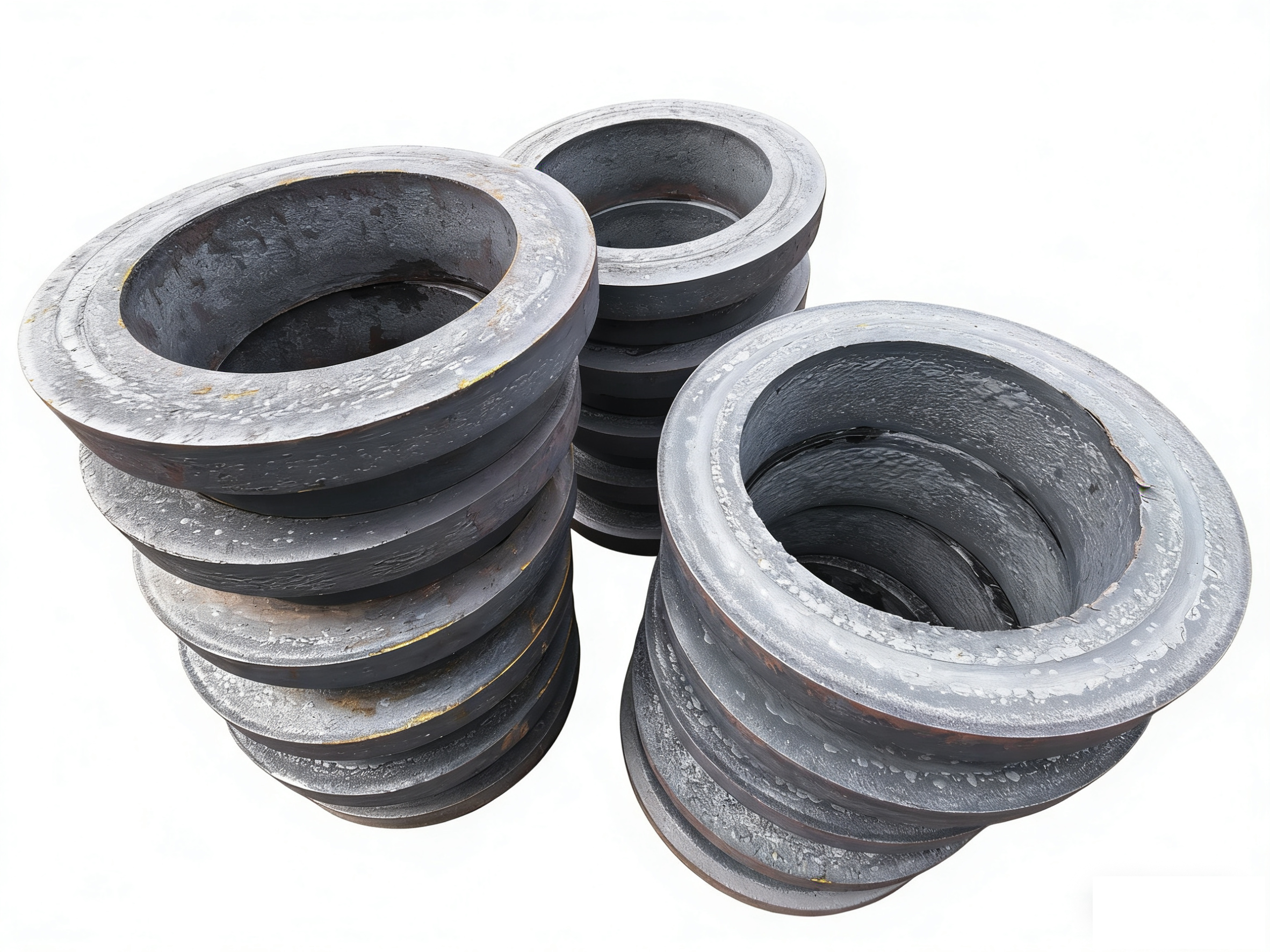
Standard carbon steels fail under extreme stress, high internal pressures, or severe cyclic loading. Alloy steels solve this problem. Metallurgists add specific elements to the steel matrix to alter its high-temperature stability, hardenability, and mechanical limits. You must understand how these additions change the metal's behavior under the hammer and in the heat treatment furnace.
Each alloying element serves a specific metallurgical function. You do not just add elements randomly; you engineer the chemistry to meet the field application.
Effects of Common Alloying Elements in Forging Steels | ||
Alloying Element | Primary Metallurgical Effect | Impact on Forging and Processing |
|---|---|---|
Chromium | Increases hardenability and wear resistance. | Requires higher forging temperatures; increases scaling. |
Molybdenum | Enhances high-temperature strength; prevents temper embrittlement. | Increases deformation resistance under the hammer. |
Nickel | Improves low-temperature impact toughness and ductility. | Reduces machinability; increases raw material costs. |
Vanadium | Refines grain structure; elevates yield strength. | Requires strict temperature control to prevent grain growth. |
Manganese | Increases overall hardenability and tensile strength. | Improves surface quality but can increase quench cracking risks. |
Chromium-molybdenum grades, specifically 4140 and 4340, dominate high-stress engineering applications. They offer a superior strength-to-weight ratio compared to standard carbon steels. These grades exhibit deep hardening capabilities. A uniform hardness profile develops throughout the entire cross-section of the part after quenching and tempering, rather than just hardening the surface. They serve as the standard for high-pressure, high-cycle applications. Engineers mandate 4140 and 4340 for components like Custom Hydraulic Cylinder Forging Parts. These cylinders must withstand massive internal hydraulic pressures without yielding or ballooning.
Nickel-alloy steels excel in cryogenic environments. Standard carbon steels become dangerously brittle at sub-zero temperatures, shattering under impact. The addition of nickel maintains the metal's impact toughness and ductility in extreme cold. Applications in arctic drilling, liquefied natural gas (LNG) transport, and high-altitude aerospace rely heavily on high-nickel grades. You must evaluate the significant raw material premiums associated with high-nickel content before specifying these grades. They also require slower, more deliberate machining feeds and speeds to prevent work hardening the surface.
Corrosive environments and extreme heat rapidly degrade standard alloy steels. Rust and oxidation compromise structural integrity, leading to catastrophic failures. Stainless steels and superalloys provide the necessary chemical resistance and thermal stability for these harsh conditions.
Austenitic stainless steels, such as 304 and 316, contain high levels of chromium and nickel. They offer exceptional corrosion resistance. However, they cannot be hardened through standard heat treatment processes like quenching. You can only increase their strength through cold working. Martensitic stainless steels, like 410, contain less nickel and more carbon. They provide lower baseline corrosion resistance but respond excellently to heat treatment. You can harden martensitic grades to achieve high mechanical strength and wear resistance.
Forging stainless steel presents distinct challenges on the shop floor. These grades exhibit higher deformation resistance than carbon steel. They do not flow as easily into complex die cavities. They require heavier forging equipment, higher tonnage presses, and highly precise temperature control. If you forge austenitic stainless outside its narrow temperature window, you risk grain boundary sensitization, which destroys its corrosion resistance.
Marine environments, chemical processing plants, and power generation facilities demand stainless steel components. The resistance to pitting and chloride stress corrosion cracking is mandatory when exposed to saltwater or acidic compounds. These sectors frequently utilize High Strength Seamless Rolled Ring Forgings manufactured from 316L or duplex stainless grades. These seamless rings serve as critical flanges, valve bodies, and bearing races in highly corrosive environments where standard steel would dissolve.
Superalloys push the boundaries of metallurgical performance. Nickel-based alloys (like Inconel) and titanium alloys maintain their mechanical integrity at temperatures where standard steels melt, warp, or oxidize completely. Aerospace engine components, gas turbine blades, and nuclear reactor internals rely on superalloys. Extreme heat and highly corrosive environments intersect in these applications. Forging superalloys requires highly specialized equipment. The material resists deformation even at extreme forging temperatures. You must account for severe raw material premiums, rapid die wear, and extended machining times when specifying superalloys.
Many industrial applications require properties that ferrous metals simply cannot provide. Non-ferrous alloys offer unique advantages in weight reduction, thermal conductivity, and magnetic permeability. You must adjust your forging parameters significantly when working with these materials.
Aluminum alloys deliver an exceptional strength-to-weight ratio. Grades like 6061 and 7075 provide mechanical strength rivaling some carbon steels at a fraction of the weight. Aluminum naturally forms a protective oxide layer, offering inherent corrosion resistance without secondary coatings. The aerospace and lightweight automotive sectors rely heavily on forged aluminum components. Suspension parts, aircraft bulkheads, and high-performance engine mounts utilize aluminum to reduce overall system weight and improve fuel efficiency. Following the forging process, aluminum parts typically undergo a T6 solution heat treatment and artificial aging process to maximize yield strength.
Brass and copper alloys serve highly specialized functions. They provide superior electrical and thermal conductivity. They also possess non-sparking properties. Environments containing volatile gases, petrochemicals, or explosive dust require non-sparking tools and components to prevent ignition. Specialized industrial valves, heavy-duty electrical connectors, and marine hardware frequently utilize forged brass and copper. These materials also offer excellent machinability, allowing for high-speed threading and drilling operations after the forging process.
Non-ferrous metals require significantly lower forging temperatures compared to steel. Aluminum typically forges between 400°C and 500°C. Steel requires temperatures exceeding 1100°C. Despite the lower heat requirements, non-ferrous forging demands strict temperature control. Overheating aluminum causes rapid grain growth, blistering, and complete material degradation. Underheating leads to incomplete die filling and internal cracking. You must utilize precision induction heating systems to maintain exact billet temperatures before striking the metal.
Tool steels represent a highly specialized category of forging materials. Engineers formulate these grades to withstand extreme wear, high impact, and severe thermal cycling. They primarily serve as the tooling used to forge other metals, rather than the final production parts themselves.
H13 chromium hot-work tool steel dominates the forging die industry. It offers exceptional hot-hardness. It maintains its structural integrity and resists softening even when continuously exposed to red-hot steel billets during high-volume production runs. H13 also provides excellent thermal fatigue resistance. It withstands the rapid heating and cooling cycles inherent in the drop forging process without developing heat checks or surface cracks on the die face. You will find H13 used extensively for hot-work forging dies, extrusion tooling, and die-casting molds.
DB6 tool steel provides high toughness and extreme wear resistance. It serves applications involving massive impact forces. Heavy-duty drop forging anvils, large hammer dies, and high-impact backing blocks utilize DB6. It absorbs massive kinetic energy from the forging hammer without fracturing or deforming.
You must frame tool steels purely for specialized, high-wear tooling or highly specific high-impact components. They possess poor machinability, requiring slow speeds, rigid setups, and frequent insert changes. They require specialized heat treatments involving multiple tempering cycles to achieve the correct balance of hardness and toughness. The raw material costs are exceptionally high. Never specify tool steels for standard structural components.
Selecting a material grade requires evaluating processing difficulty and production scalability. A theoretical material match means nothing if you cannot manufacture the component efficiently at scale on the shop floor.
You must analyze the relationship between raw material selection and secondary processing requirements. Specifying a cheaper, lower-tier alloy often incurs extensive secondary processing. A lower-grade steel might require complex, multi-stage heat treatments to achieve the necessary hardness. A highly alloyed material might prove so difficult to machine that tooling replacements negate any initial material savings. You must evaluate the entire manufacturing sequence, from billet cutting to final grinding.
Production scalability depends heavily on material availability and forging die wear. Exotic alloys and specialized superalloys suffer from long procurement lead times. They also accelerate die wear exponentially. Forging Inconel or Titanium degrades H13 dies rapidly, requiring frequent tooling replacements and halting production. You must evaluate how die wear impacts the feasibility of high-volume production runs. Standard carbon and low-alloy steels support rapid, high-volume scalability with minimal tooling disruption.
Compliance and certification dictate material selection in regulated industries. You must match material grades to industry-specific regulatory standards. The oil and gas sector mandates strict adherence to API (American Petroleum Institute) specifications regarding sour gas resistance and yield strength. The aerospace industry requires AS9100 compliance and rigorous material lot traceability. Failing to specify a pre-approved, certified grade halts production and invalidates the final component.
Comparison of Common Forging Material Categories | ||||
Material Category | Typical Grades | Primary Advantage | Machinability | Typical Industrial Application |
|---|---|---|---|---|
Medium Carbon Steel | 1045, 1050 | Balanced strength and ductility | Excellent | Standard shafts, gears, flanges |
Alloy Steel | 4140, 4340 | Deep hardenability, high yield strength | Good | Hydraulic cylinders, high-stress axles |
Austenitic Stainless | 304, 316 | Superior corrosion resistance | Fair | Marine hardware, chemical valves |
Aluminum Alloys | 6061, 7075 | High strength-to-weight ratio | Excellent | Aerospace bulkheads, automotive suspension |
Hot-Work Tool Steel | H13 | Extreme thermal fatigue resistance | Poor | Forging dies, extrusion tooling |
Procuring the correct material grade on paper does not guarantee component integrity. Raw material defects and chemical deviations introduce severe implementation risks. You must enforce rigorous validation protocols before the metal ever enters the furnace.
Lower-tier steel billets frequently contain subsurface defects and non-metallic inclusions. Slag, oxides, and internal voids compromise the structural integrity of the final forging. When subjected to high loads, these inclusions act as stress concentrators, initiating fatigue cracks that propagate through the part. You must source raw materials from reputable mills that utilize vacuum degassing or argon oxygen decarburization (AOD) to minimize inclusions and ensure clean steel.
Strict dimensional and chemical checks must occur before the heating and forging stages begin. Verifying raw billet dimensions ensures sufficient material volume to fill the forging die completely. Undersized billets lead to incomplete parts with unfilled corners. You must also verify strict chemical composition tolerances. A slight deviation in carbon or chromium content drastically alters the material's response to heat treatment, resulting in parts that are either too soft or dangerously brittle.
You must mandate the use of Non-Destructive Testing (NDT) on both raw billets and finished forgings. Ultrasonic Testing (UT) sends high-frequency sound waves through the metal to detect internal voids, piping, and subsurface cracks. Magnetic Particle Inspection (MPI) identifies surface and near-surface discontinuities in ferromagnetic materials by applying a magnetic field and iron particles. Dye Penetrant Inspection reveals microscopic surface cracks in non-magnetic alloys like aluminum and austenitic stainless steel. These tests mitigate the risk of catastrophic field failures.
Material traceability remains a critical requirement. You must demand Material Test Reports (MTRs) for every batch of raw material. The MTR provides the exact chemical breakdown and mechanical properties of that specific heat lot. You should also utilize optical emission spectrometry to verify the chemical composition independently upon material receipt. This ensures the supplied grade matches the engineering specification exactly and prevents counterfeit materials from entering your supply chain.
Take the following steps to finalize your material selection and initiate production:
Define the absolute maximum operational stress thresholds and environmental exposures for your specific component.
Select the baseline material grade that meets these requirements with an appropriate safety margin, avoiding unnecessary over-specification.
Request verified Material Test Reports (MTRs) from your forging partner to guarantee chemical composition and traceability.
Evaluate your internal machining capabilities against the expected as-forged hardness of the shortlisted materials.
Initiate a prototype run using the selected grade to validate directional grain flow, die fill, and dimensional stability.
A: 1045 is a medium carbon steel offering good baseline strength and excellent machinability for standard applications. 4140 is a chromium-molybdenum alloy steel. The added alloying elements give 4140 significantly higher yield strength, deeper hardenability, and better fatigue resistance, making it mandatory for high-stress components.
A: Forging applies extreme pressure to heat-softened metal, forcing the internal grain structure to deform and align with the shape of the component. This creates directional grain flow. This continuous, unbroken grain structure significantly increases the part's impact strength and fatigue resistance compared to machined or cast alternatives.
A: Yes. Aluminum and brass are frequently forged. Aluminum forgings provide high strength-to-weight ratios for aerospace and automotive parts. Brass forgings offer high electrical conductivity, thermal conductivity, and non-sparking properties for specialized valves and electrical connectors. They require much lower forging temperatures than steel.
A: MTRs guarantee material traceability. They provide certified documentation of the exact chemical composition, heat treatment history, and mechanical properties of a specific metal batch. They prove the raw material meets the required engineering specifications, mitigating liability and preventing field failures caused by substandard metal.
A: Yes, stainless steel can be drop forged. However, it presents higher deformation resistance than carbon steel. It requires higher tonnage forging equipment, heavier die wear allowances, and highly precise temperature controls to prevent surface cracking and internal material degradation during the forging process.
A: The most common non-destructive tests include Ultrasonic Testing (UT) to detect internal voids, Magnetic Particle Inspection (MPI) to find surface and near-surface cracks in ferrous metals, and Dye Penetrant Inspection to reveal microscopic surface flaws in non-magnetic materials.
A: Chromium increases hardenability and provides baseline corrosion resistance. Molybdenum improves high-temperature strength and deep hardenability while preventing brittleness. Tungsten delivers extreme wear resistance and maintains material hardness at highly elevated temperatures, making it ideal for tooling applications.


