
Views: 0 Author: Site Editor Publish Time: 2026-08-19 Origin: Site


The structural integrity and lifecycle cost of industrial components are fundamentally dictated by the manufacturing process chosen before the first die is ever cut. Specifying the wrong forging method leads to excessive tooling wear, unnecessary secondary machining operations, or catastrophic component failure under dynamic loads. Engineering and procurement teams must balance mechanical requirements against production volume economics. This guide provides a rigorous framework for evaluating hot versus cold forging processes. We detail metallurgical outcomes, dimensional capabilities, and overall production efficiency to ensure the correct specification for heavy-duty applications. You will learn how temperature alters crystalline structures and dictates final mechanical properties. We also cover die wear, material yield, and production run thresholds. By understanding these variables, you can align part geometry with process capabilities and avoid costly supply chain bottlenecks.
Recrystallization is the Defining Metric: Cold forging occurs at or near room temperature, maximizing yield strength through strain hardening, while hot forging operates above the metal's recrystallization temperature (e.g., 950°C to 1250°C for steel) to allow severe deformation without fracturing.
Tolerance vs. Complexity: Cold forging delivers superior surface finish and tighter initial tolerances, whereas hot forging accommodates highly complex geometries and massive component sizes that cold working cannot achieve.
Total Cost of Production: Cold forging requires higher initial tooling investments and heavier press loads but minimizes downstream machining and material waste. Hot forging lowers initial press force requirements but often necessitates secondary operations and flash trimming.
Material Suitability: Lower carbon steels and softer alloys are prime candidates for cold forging; high-alloy steels, titanium, and superalloys typically require hot forging.
Understanding how temperature alters the crystalline structure of metal is necessary for predicting the final mechanical properties of forging parts. The thermal environment during plastic deformation directly dictates the material's internal grain structure, dislocation density, and ultimate performance under load. We see this daily on the shop floor. If you push a material past its limits without the right thermal support, dies crack and parts fail.
Cold forging compresses metal at or near room temperature. This process relies entirely on the material's inherent ductility to flow into the die cavity without the aid of thermal softening. Because the metal remains well below its recrystallization point, the crystalline lattice undergoes severe distortion during deformation. We frequently use massive mechanical presses capable of delivering 1,000 to 3,000 tons of force in a fraction of a second. The kinetic energy transferred to the workpiece is immense. Operators must monitor die temperatures even in cold forging, as the internal friction generates significant localized heat.
Manufacturers employ several distinct techniques to achieve near-net geometries without heat. Upsetting reduces the length of a billet while increasing its diameter. We use this constantly for fastener heads. Forward and backward extrusion force the material through an orifice or around a punch to create complex cylindrical or hollow shapes. Coining applies massive localized pressure to impart precise surface details and achieve exact dimensional sizing.
The defining metallurgical outcome of cold working is strain hardening, also known as work hardening. As the metal deforms, dislocations within the crystal lattice multiply and entangle. This entanglement restricts further dislocation movement. It exponentially increases the material's tensile and yield strength. However, this strength increase comes at the direct cost of ductility.
Friction management dictates success in cold forging. The extreme pressures required to move cold metal generate immense shear forces at the die-workpiece interface. Advanced chemical lubrication systems are mandatory. Zinc phosphate coatings combined with reactive stearate soaps create a robust boundary layer. This prevents catastrophic die galling and tooling failure under high-tonnage loads.
Despite its advantages, cold forging faces strict limitations regarding material ductility. High-carbon steels and complex alloys lack the necessary plasticity at room temperature. Forcing these materials into complex shapes cold will exceed their fracture toughness. You will see severe cracking or explosive die failure.
Hot forging fundamentally changes the physics of deformation by heating the workpiece above its recrystallization threshold. For steel alloys, this means crossing into the austenite phase, typically between 950°C and 1250°C. At these temperatures, the metal achieves a highly plastic state. This allows for massive volumetric displacement with significantly lower press tonnage. Induction heating systems are the standard on modern shop floors. They provide rapid, uniform heating throughout the billet cross-section. Gas furnaces are still used for massive open-die forgings, but they introduce higher risks of surface decarburization if the atmosphere is not strictly controlled.
The process is generally divided into open-die and closed-die categories. Open-die forging manipulates massive, low-volume shapes between flat or simply contoured dies. It relies on the operator's skill to achieve the final geometry. Closed-die, or impression-die forging, forces the heated billet into highly complex, repeatable cavities. It fills intricate geometric features that would be impossible to form cold.
The main advantage of hot forging is continuous dynamic recrystallization. As the metal deforms, the distorted grains immediately nucleate into new, strain-free grains. This prevents strain hardening entirely. The material can undergo massive plastic deformation without structural failure. Engineers can design highly complex, asymmetrical components.
Operating at extreme temperatures introduces thermal realities that must be engineered into the process. Metals expand when heated and contract as they cool. This thermal contraction is not always perfectly uniform. It requires specific tolerance allowances and die design modifications to ensure the final cooled component meets dimensional specifications.
Evaluating the mechanical outcomes of hot and cold forging requires mapping specific metallurgical changes to real-world performance criteria. The chosen process directly dictates how a component will survive under fatigue, impact, and shear stresses.
Both hot and cold forging produce a continuous grain flow that contours to the geometry of the part. This is a massive structural advantage over components machined from solid bar stock. When you section and etch a forged component, the grain lines visually trace the exterior contours. This uninterrupted flow acts like the grain in a piece of wood, providing maximum strength along its length. Machining cuts across these lines, exposing end-grains that are highly susceptible to fatigue cracking under cyclic loading.
Cold forging produces highly directional grain structures. Because the metal does not recrystallize, the elongated grains remain tightly packed along the primary axis of deformation. This creates exceptional fatigue resistance and directional strength. Cold-forged components are ideal for specific load paths where the stress vectors are highly predictable.
Engineers must carefully evaluate the inverse relationship between strength and ductility when specifying cold-forged components. While strain hardening pushes the yield strength to its absolute maximum, the resulting part becomes significantly more brittle. If a cold-forged part is subjected to an impact load exceeding its yield point, it is more likely to fracture than deform.
Hot forging yields a completely homogenous, equiaxed grain structure. The continuous recrystallization eliminates internal residual stresses. It offers superior ductility, fracture toughness, and impact resistance. This makes hot forging the mandatory choice for components subjected to unpredictable shock loading or extreme vibration.
Consider the material and operational requirements for a High Strength Forged Steering Bracket. This suspension component must survive continuous dynamic loading, road impacts, and high-torque steering inputs without catastrophic failure. While high yield strength is necessary to maintain geometry under load, maximum ductility is required to ensure the bracket bends rather than shatters during a severe impact. Therefore, hot forging is typically specified to achieve the exact strength-to-weight ratio and impact toughness required for automotive safety compliance.
The near-net shape capabilities of a manufacturing process determine how much secondary processing is required before the part is ready for assembly. Evaluating dimensional accuracy streamlines the production pipeline.
Cold forging is renowned for its exceptional precision. Because there is no thermal expansion or contraction, the part geometry mirrors the die cavity exactly. Manufacturers routinely achieve tight tolerance bands, often falling within IT7 to IT9 classifications, directly off the press.
The absence of heat completely eliminates scaling, oxidation, and decarburization. The resulting surface finish is vastly superior to hot-worked metals. It often achieves Ra values smooth enough to bypass secondary grinding or polishing operations entirely. This near-net capability drastically reduces downstream manufacturing bottlenecks.
High-heat processes introduce unavoidable surface degradation. When steel is heated above 900°C in an ambient atmosphere, the surface reacts with oxygen to form iron oxide scale. This scale is highly abrasive and must be removed via shot blasting or tumbling. The high heat causes surface decarburization, slightly altering the chemical composition of the outer layer.
Closed-die hot forging also inherently generates flash. To ensure the die cavity fills completely, excess material is forced out between the die halves. This flash must be removed through a secondary mechanical trimming operation.
Due to thermal contraction during the cooling phase, hot forging requires wider tolerance bands. Predicting the exact shrinkage rate across complex, asymmetrical geometries is difficult. Hot-forged parts cannot match the out-of-the-press precision of cold-forged alternatives.
Because hot forging cannot hold tight tolerances on critical mating surfaces, secondary machining is almost always required. The hot forging process provides the bulk geometry rapidly and efficiently. It leaves only minimal material removal for the final machining centers. When setting up a hot-forged part in a CNC lathe or mill, operators must account for the hard outer scale. We typically program a heavy initial depth of cut to get under the abrasive oxide layer immediately. Taking light finishing passes on raw forging scale will destroy carbide inserts in minutes.
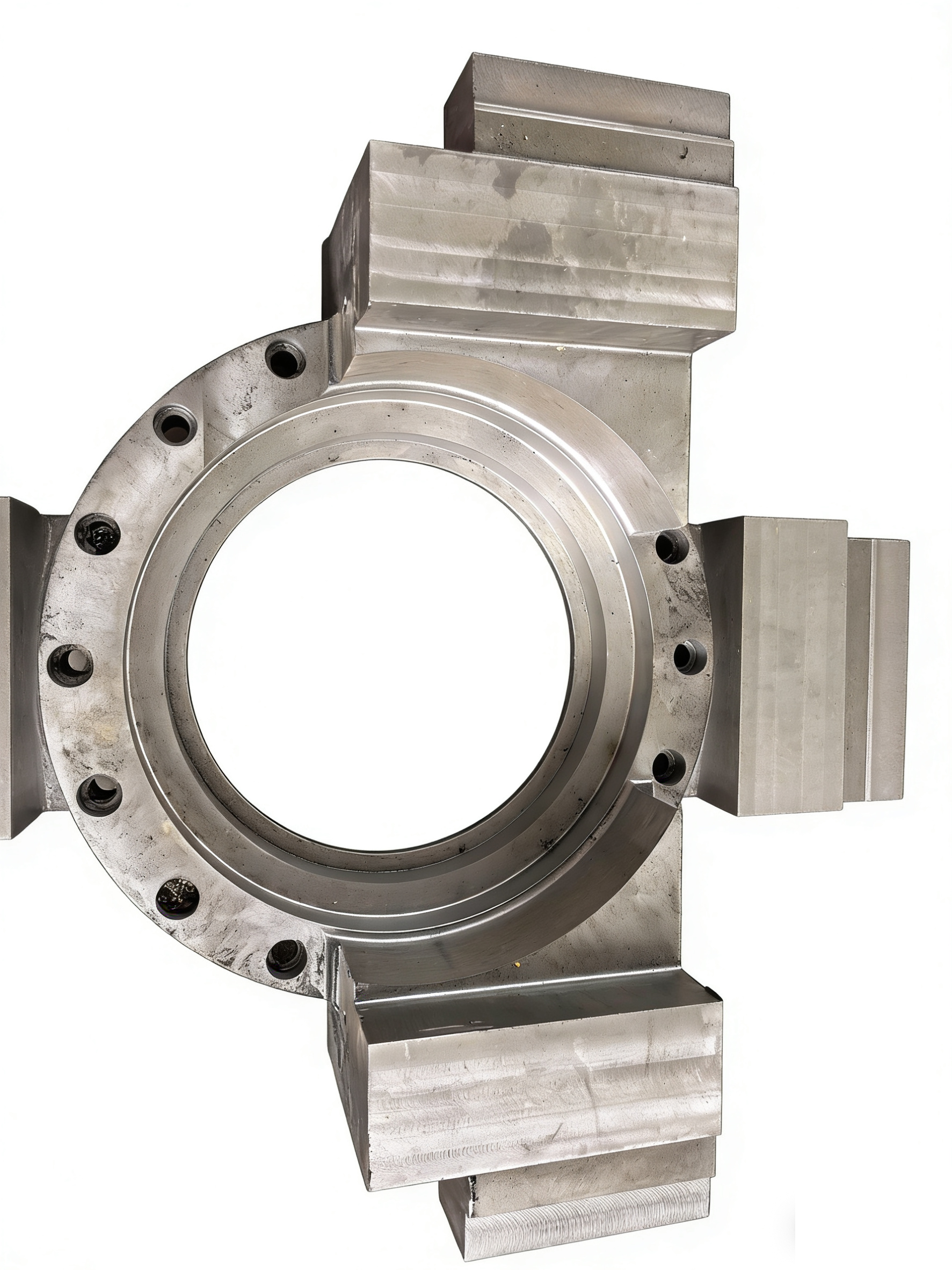
This hybrid approach is perfectly illustrated in scenarios requiring a Custom CNC Machined Flange Forging. The flange's massive outer diameter and structural hub are hot forged to establish the continuous grain flow and impact resistance required for high-pressure piping systems. Subsequently, CNC machining is utilized to cut the final bolt hole patterns, face the sealing surfaces, and achieve the exact flatness tolerances required for leak-proof mating.
It is also necessary to evaluate post-forging heat treatments. Hot-forged parts often undergo normalizing or annealing to refine the grain structure further. This relieves internal cooling stresses and optimizes the material's machinability before it reaches the CNC lathe.
To clarify the operational differences, review the following technical parameters comparing both methods.
Parameter | Cold Forging | Hot Forging |
|---|---|---|
Operating Temperature | Room temperature (up to 150°C) | 950°C to 1250°C (for steel) |
Typical Tolerances | IT7 to IT9 | IT10 to IT14 |
Surface Finish (Ra) | 0.4 to 1.6 µm | 6.3 to 12.5 µm |
Die Material | Tungsten Carbide, D2 Tool Steel | H13 Tool Steel, FX Alloy |
Material Yield | Near 100% | 70% to 90% (due to flash) |
Analyzing the overall value and production efficiency requires looking far beyond the per-part material price. Tooling lifespan, energy consumption, and production volume thresholds dictate the true financial viability of the chosen forging method.
The tooling economics between the two processes differ drastically. Cold forging requires extreme pressure to move solid metal. This necessitates massive, highly rigid presses and exceptionally robust tooling. We often utilize expensive tungsten carbide inserts. While the initial tooling cost is high, the lack of thermal shock means cold forging dies can last for hundreds of thousands of cycles if lubricated correctly.
Hot forging dies face a completely different wear mechanism. They are subjected to severe thermal fatigue. They constantly cycle between the extreme heat of the billet and the cooling spray of die lubricants. The iron oxide scale on the heated billet acts as an abrasive, actively wearing away the die cavity. Consequently, hot forging dies require frequent resurfacing and replacement, increasing ongoing maintenance costs.
Cold forging offers near 100% material utilization. The exact volume of the starting billet is calculated to fill the die cavity perfectly. It generates zero flash and virtually no scrap. This is a massive economic advantage when working with expensive alloys.
Hot forging generates unavoidable scrap through flash trimming. This can account for 10% to 30% of the starting billet weight. While this scrap is recyclable, it represents lost energy and processing time.
The energy footprint also differs significantly. Hot forging requires massive induction heaters or gas furnaces to bring the material to the austenite phase. It consumes vast amounts of energy before the press even cycles. Cold forging eliminates furnace heating but requires significantly higher electrical loads to drive the massive mechanical or hydraulic presses required for room-temperature deformation.
Calculating the break-even point is necessary for procurement engineering. High-volume production runs heavily favor cold forging. The high initial tooling and press costs are rapidly amortized over millions of parts. The savings from near-net material yield and eliminated machining operations compound continuously.
Low-to-medium volume runs, or projects requiring massive component sizes, favor hot forging. The lower initial press tonnage requirements and cheaper die materials make it economically viable for smaller batches. The massive capital expenditure of cold forging tooling cannot be justified for short runs.
Matching the forging process to industry-specific compliance and performance standards requires a strict features-to-outcomes evaluation.
Heavy machinery and commercial drivetrains operate under extreme mechanical stress. They require massive components that can withstand continuous torque and shear forces.
Analyze the production of a Heavy Duty Forged Steel Drive Yoke. This component connects the driveshaft to the differential. It transfers immense rotational torque while absorbing driveline vibrations. The massive physical size of a commercial drive yoke makes cold forging impossible due to press tonnage limitations. The yoke requires maximum fracture toughness to prevent shearing under sudden acceleration loads. Hot forging is strictly required to achieve the necessary equiaxed grain structure and part volume. This is followed by precision CNC machining of the splines and bearing caps.
Cold forging dominates the automotive sector for high-volume fasteners, pins, shafts, and gears. The ability to produce millions of identical, high-strength components with zero material waste and no secondary machining aligns perfectly with automotive supply chain economics.
In contrast, the aerospace industry relies heavily on hot forging. Aerospace structural components are frequently manufactured from titanium alloys or nickel-based superalloys like Inconel. These materials possess incredibly high yield strengths and resist deformation even at elevated temperatures. Attempting to cold forge these superalloys is physically impossible. They must be hot forged under highly controlled thermal conditions to achieve the required aerodynamic geometries and fatigue resistance.
Identifying common failure points in the procurement and specification phase prevents costly manufacturing delays and ensures structural compliance.
A primary risk is specifying a high-carbon or highly alloyed steel for a cold forging process. These materials lack the necessary room-temperature ductility. Attempting to cold work them will lead to immediate part fracturing or catastrophic die failure under press load.
To mitigate this, engineers must utilize intermediate annealing processes. Heating the part between cold forging stages restores ductility. Alternatively, shift the process to warm forging. Warm forging operates below the recrystallization threshold but above room temperature (e.g., 600°C to 800°C for steel). This reduces press loads and improves plasticity while maintaining tighter tolerances than traditional hot forging.
Procurement teams often underestimate the lead time required for complex cold-forging die design and validation. Because the metal flow is highly restricted at room temperature, designing cold forging tooling requires extensive finite element analysis (FEA) and multiple physical trial runs to prevent die cracking.
The mitigation strategy requires engaging forging partners heavily during the Design for Manufacturing (DFM) phase. By aligning the part geometry with the specific capabilities of the forging press early in the design cycle, engineers can eliminate impossible radii, optimize draft angles, and significantly reduce tooling validation lead times.
Follow these specific DFM steps to reduce lead times:
Run finite element analysis on the initial CAD model to identify high-stress flow areas.
Adjust draft angles to ensure smooth ejection from the die cavity.
Select a die lubricant specifically formulated for the chosen alloy and press tonnage.
Conduct a small-batch physical trial to verify dimensional stability before full production.
Audit your current component portfolio to identify machined-from-solid parts that can be converted to near-net cold forgings to reduce material waste.
Evaluate the impact loading requirements of your structural components to determine if the continuous recrystallization of hot forging is mandatory for safety compliance.
Engage a metallurgical engineer during the design phase to verify that your selected steel alloy possesses the correct ductility profile for your intended forging temperature.
Prepare a comprehensive RFQ that includes 3D CAD models, exact material specifications, dynamic load requirements, and estimated annual usage to accurately compare tooling amortization costs.
A: Cold forging occurs at or near room temperature, relying on raw mechanical force. Hot forging requires heating the metal above its recrystallization point. For steel, this is typically between 950°C and 1250°C. This allows the material to deform plastically without strain hardening.
A: No. Only metals with high inherent ductility and low initial yield strength are suitable for cold forging. Examples include low-carbon steels, aluminum alloys, and brass. High-carbon steels and superalloys will crack or shatter if cold worked without intermediate annealing.
A: Cold forging drastically increases yield and tensile strength through strain hardening and dislocation entanglement. However, hot forging produces a homogenized, equiaxed grain structure. This provides superior ductility, fracture toughness, and impact resistance under dynamic loads.
A: Yes. Hot-forged parts almost always require secondary CNC machining to achieve critical mating dimensions. This is due to unpredictable thermal contraction during cooling, surface scale generation, flash trimming requirements, and wider inherent tolerance bands.
A: Warm forging heats the metal above room temperature but strictly below the recrystallization threshold. It is used as an engineering compromise. It reduces press tonnage requirements and improves material flow while maintaining tighter dimensional tolerances than hot forging.
A: Cold forging requires massive initial capital for robust tooling and high-tonnage presses. It necessitates high production volumes to achieve a return on investment. Hot forging utilizes cheaper tooling and lower press loads, making it adaptable to lower volumes and massive components.
A: Cold forging offers near 100% material yield with zero flash and avoids the massive energy consumption of industrial heating furnaces. Hot forging consumes significant energy to heat the billets and generates unavoidable material scrap via the flash trimming process.


